
Charlotte Nichols and the Proudmanisation of Westminster
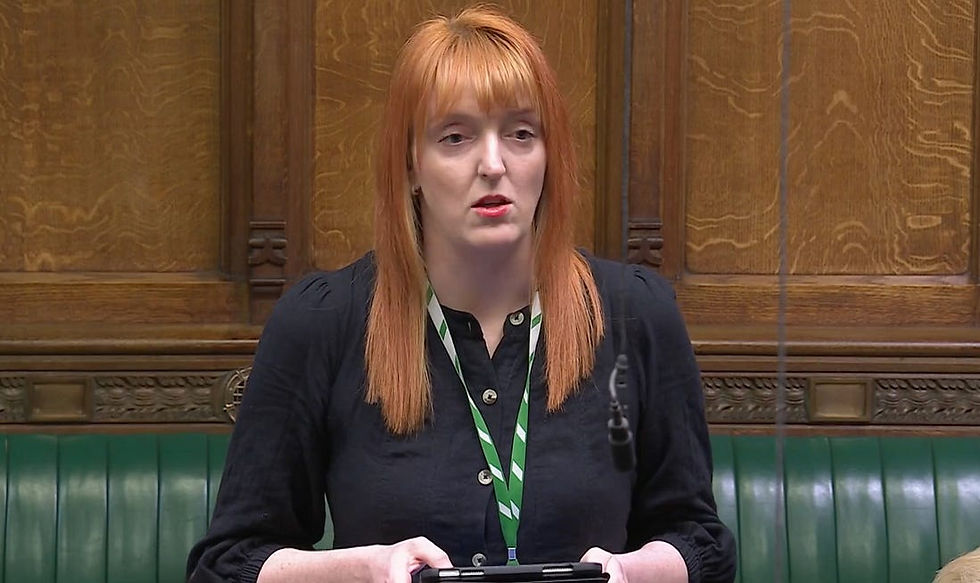
Charlotte Nichols, Member of Parliament, Warrington North.
Since 2015, when a fellow barrister wrote flattering remarks on her LinkedIn profile and she outed him for it, Charlotte Proudman has been fighting the patriarchy in law and beyond. Whether it’s equal pay, manspreading, rape or the Garrick Club, if Proudman sees a speck of perceived male privilege, she’s there. Her ‘inspirational’ girl-boss ways seem to have now found themselves transplanted onto the backbenches of the House of Commons.
On March 10 2026, another Charlotte, Nichols (MP) waived her right to anonymity in the House to reveal she was raped while attending an event in her capacity as a Member of Parliament (MP). She shared the experience from her point of view during a debate on David Lammy’s Courts and Tribunals Bill, which proposes limiting jury trials to address court backlogs - a move she strongly opposed.
However, ‘Her attacker was acquitted at the Crown Court’ reported the Metro/Google and a dozen X accounts, which begs the question how not guilty does one have to be found to not be labelled an ‘attacker’ in the mainstream media? Nichols chose to disclose about her own alleged rape, which was actually revealed to be not quite ‘rape’ as the public might see it, since her accused was found not guilty in a criminal court.
While Nichols has parliamentary privilege, does that include misleading the House as to what actually happened? Speaker Lindsay Hoyle or his deputy remain(ed) silent on the matter. Will no MP call it out? No, since no one in the House of Commons seems to have the courage to call out the dominant VAWG (Violence Against Women and Girls) narrative, however biased it may be.
No wonder some want juries abolished, if this is how potentially false or spurious allegations are going to turn out. Not that Nichols did. She instead accused her own party’s government, specifically Justice Secretary David Lammy, of using victims as a "cudgel" or "weaponising" their trauma to push through reforms that curb access to jury trials. She argued that the proposed Bill would not materially help rape victims and instead called for the creation of specialist (alleged) rape courts.
This ‘Court for Allegations of Rape’ (a more accurate title) idea is not a bad one, provided the judges, lawyers and potential jurors involved are aware that the only ‘rape myths’ that exist are the ‘rape myths’ themselves, as law correspondent Joshua Rozenberg put it in a Substack article last year. The adversarial system so beloved by modern-day Rumpoles like Geoffrey Cox, Mike Mansfield and co doesn’t suit the human complexity of such trials. Film director, researcher and survivor of false allegations himself Patrick Graham has done the actual statistical work to find there are in fact between 55,000 and 70,000 false allegations of rape per year in the UK, numbers further explored in Dr Michael Naughton of Empowering the Innocent’s recent paper on the subject which starts on page 75 here: https://criticalsocialtheory.com/wp-content/uploads/2026/01/cp-vol-1-no.-2-1.pdf.
Felicity Stryjak of the False Accusations Database and FACT (Falsely Accused in the Context of Trust, presided over by former MP Harvey Proctor) said:
'The double standard is staggering. Convicted rapists, (always men), are expected to accept a guilty verdict without question, their punishment more intense if they maintain innocence. Rape complainants, (overwhelmingly women), on the other hand, can refuse to accept an acquittal, and demand another bite at the cherry through the civil court. Lady Justice seems to have two faces.'
A commenter on X named Carrie E said:
‘It’s not revealed to be “not a rape” because someone was found not guilty. She was raped, the accused was found not guilty. If someone is found NG it doesn’t mean the offence didn’t take place.’
Carrie, possibly inadvertently, points out why the push of misandrist feminism to make rape perceived to be ‘worse than murder’ in society is so doomed to failure. In murder and manslaughter at least the law (usually) has a dead body to refer to. In allegations of rape and sexual assault all it has is usually he said/she said, and an ever-increasing amount of incentivisation on the side of the accuser.
Charlotte Nichols wasn’t delivered by stork into Westminster yesterday, however. ‘An MP who allegedly had to be taken out of an airport in a wheelchair after getting drunk on a flight to an Armistice Day commemoration event today blamed a reaction to medication’ (see
https://www.standard.co.uk/news/uk/charlotte-nichols-labour-mp-drunk-armistice-day-gibraltar-b965640.html). We’ve all been there.
Regarding the disclosure of Nichols’ alleged rape, a source who attended the trial of her alleged rapist said:
‘In 2021, a party took place at a hotel, and Nichols stayed over in the defendant's room. Both say they had sex three times. The accused said it was all consensual, while Nichols said while the first time was consensual, the other two times were rape. Nichols stayed in the accused’s room the next day (Sunday) until lunchtime. The second charge was about photos he took and sent by WhatsApp to his friends. Although the trial was in 2024, the law applied had to be as it was at the time of the event in 2021, which said at the time that photos sent had to be to cause harassment and distress. He was found not guilty on that too.’
A Pat Chanse on X said:
'One man was accused by eleven women, independent of each other, two dropped out, five had insufficient evidence, so weren't pursued and four went to court. He was acquitted on all four counts'.
This was contradicted, however, by the source who attended the trial cited above, who clarified:
'The case was reported at the time, although obviously evidence which would've compromised Nichols's anonymity wasn't published. The Jury was made up of 7 men and 5 women, and took under 4 hours to reach a not guilty verdict'.
The fact is that while Nichols’ complaint was upheld by the civil court later, the higher bar in the criminal court wasn’t reached, according to a trial by jury. This means according to the law, dysfunctional as it is, Nichols calling her experience ‘rape’ in the House of Commons is misleading the House. The law says it was not. It has become a well known cliche that ‘feels’ have replaced facts in these sorts of trials - the fact that this can happen in the House of Commons, where laws are actually thrashed out, is another level altogether.
By Sean Bw Parker
Please let us know if you think that there is a mistake in this article, explaining what you think is wrong and why. We will correct any errors as soon as possible.


Comments