
#10 The CCRC, David Morris and the Clydach murders: Framing Dai Morris

We know that South Wales Police detectives cracked the Clydach murders case early on – literally within days – because former Detective Shane Ahmed said so. And, for that matter, so did former Detective Phil Rees. But more about Detective Rees at another time. This is about Shane Ahmed.
Detective Shane Ahmed, as he then was, played a small, shameful, but hugely significant part, in the Clydach murders conspiracy.
The Clydach murders occurred on the night of 26/27 June 1999. As I’ve said, the case was solved within days, but no one was arrested for a full twelve months. Only on 4 July 2000 were Stephen Lewis, Alison Lewis and Stuart Lewis taken into police custody on suspicion of their involvement in the murders.
Then, on 22 January 2000 – just over 6 months later – all three Lewises were released with no charges brought against them.
Just two months later, on 20 March 2001 David George (Dai) Morris was arrested on suspicion of the murders. They claimed that a broken gold neck chain found at the crime scene was his, and he had lost it whilst attacking the victims.
By this time, South Wales Police’s had had almost 21 months to frame Morris for the murders, an almost-illiterate builder’s labourer, and an entirely innocent man.
They had interviewed Morris, of course, not as a suspect, but as a witness, so they knew exactly what he would say when the time came to charge him.
They knew that he would vehemently deny his relationship with murder victim Mandy Power, because, to admit that they had been intimately involved, would have destroyed his relationship with his partner, Mandy Jewell.
South Wales Police detectives kept secret their knowledge that they knew all about his relationship with Mandy Power, not only because Louise Pugh had told them about it in her statement to Detectives Meyrick and Powell on Monday 28 June 1999, but also because they had already taken possession of Mandy Power’s mobile phone which disclosed a large number of intimate text messages exchanged between her and Dai Morris.
Morris’s repeated denials of his relationship with Mandy Power played right into the detectives’ hands because if he had admitted the relationship, it would remove entirely his motive for murder.
And, they knew that the broken gold neck chain found at the crime scene belonged to him because, once again, Louise Pugh had told Detectives Meyrick and Powell in her statement. He had left it in the house when he called to have sex with Mandy on the Friday morning before the murders.
Which left just the matter of his alibi to deal with. It is worth mentioning that no one is required to have an alibi placing a suspect elsewhere at the time a crime was committed, but it helps if you do, but only then if it can be corroborated.
Morris’s alibi was that after leaving the New Inn pub in Graig-Cefn-Parc he decided to walk the 8 miles (about 7 kms) or so to his parents’ home in Gendros on the outskirts of Swansea, but along the way, he changed his mind, turned around and went home. Since no one allegedly saw him, he had no realistic alibi for the time that three of the murders were carried out, and this factor would be used against him at his trial.
I say “allegedly”, because rumour has it that there was a witness, a woman who saw him walking through Craig-Cefn-Parc at the very time he claimed to have been there, but the witness has since died, and her statement – if there was one – is undoubtedly hidden away behind PII.
So in the 21 months that South Wales Police had to frame Dai Morris for the murders, the best they could come up with to justify his prosecution him were:
Lies he told the police, denying his intimate relationship with Mandy Power, and his ownership of the broken gold neck-chain. The police knew the chain was his, because Louise Pugh had told them so in her statement of 28 June. But the police could not use the information in Louise’s statement, because to admit its very existence would open up a whole can of worms for South Wales Police that they would rather keep hidden; and,.
His lack of a concrete alibi to cover the time when three of the murders were committed.
That was it! There was no other evidence with which to charge him. If South Wales Police had passed on their very light file of evidence to the Crown Prosecution Service, they would have been told in no uncertain terms that it was insufficient to charge Morris with the murders, let alone launch a full scale criminal prosecution.
And, this was where Detective Shane Ahmed was brought in. It was his job to obtain the one piece of evidence needed to justify the police in taking proceedings against Morris.
Shane Ahmed knew just how important his role was. If he failed to get the evidence required, Morris could not be charged, he would not become the fall guy for the Clydach murders, and South Wales Police would be obliged to look elsewhere for another victim to frame.
And this was how they did it.
After his arrest, Morris was not taken to Swansea Police Station HQ in Cockett, Swansea – where you might expect them to have taken a suspected mass-murderer with its no-expense-spared state-of-the-art equipment – instead, they took him to Morriston Police Station in the Swansea suburbs with its alleged faulty monitoring equipment.
Now, at this point, you have to ask yourself; Why would the police take this suspected mass-murderer in Wales’s worst ever murder case, to a suburban police station with defective monitoring equipment, rather than to their police HQ in Cockett less than 5 miles away.
To add insult to injury, they placed Morris and his solicitor in the very same interview room where the alleged faulty monitoring equipment was installed. Doesn’t all this strike you as highly suspicious?
And, then, Detective Shane Ahmed arrived.
When Morris and his solicitor were in the interview room conferring together, Ahmed claimed he accidentally overheard heard their conversation due to the faulty equipment, and that Morris had implicated himself in the crime.
At this time, there were other police officers in the same room as Ahmed, but they said they heard nothing.
Ahmed said he wrote down what he heard on a series of Post-It notes, which again begs the question, why did this veteran police office not use his police issue note book? Was it because his notebook might be subjected to ESDA testing and could not be tampered with, whilst the Post-It notes could be amended as required?
Morris’ solicitor, and Morris himself, later denied that Shane Ahmed’s Post-It note record was accurate, or that Morris had incriminated himself. But none of that mattered. Shane Ahmed’s disputed Post-It note record with its alleged incriminating evidence was exactly what South Wales Police had to have, to get the case into court.
And, it was on the basis of Shane Ahmed’s Post-It note record, and on this evidence alone, that Swansea Police Force launched their criminal prosecution against Morris.
When Ahmed’s Post-it note record was challenged at the start of the Crown Court proceedings, Ahmed amazingly withdrew his evidence leaving South Wales Police with absolutely no other evidence with which to charge Morris (Morris had not yet admitted ownership of the broken neck chain, although her had agreed it was “probably his”). So the charges against Morris should have been dropped there and then.
But, incredibly, this did not happen. Mr Justice Butterfield inexplicably ruled that the case against Morris should continue and the rest, as they say, is history.
And, how do we know that South Wales Police cracked the Clydach murders case within days?
Because for this, and other reasons to be disclosed later, soon after the end of the forensic search of the Lewises’ home, which began on Tuesday 29 June 1999,
Detective Shane Ahmed rang the Lewises’ next-door neighbour, David Jones, telling him, ‘We got him.’
‘Got who?’ Jones asked, wondering what and who Ahmed was talking about.
‘We got Stephen Lewis’, Ahmed replied.
‘What do you mean?’ Jones asked.
‘We got Stephen Lewis up the mountain with a kitbag,’ Ahmed replied.
Ahmed did not divulge the identity of the witness who had seen Stephen Lewis with a kitbag, but it is clear that he was expressing his delight that South Wales had cracked the case, and he could not wait to share this information with someone, and that someone was David Jones.
In the 2021 BBC documentary The Clydach Murders: Beyond Reasonable Doubt, a new witness, John Allen came forward. He said that at about 4.30 pm on the morning after the murders, he saw a man walking on Mountain Road near Clydach with a green kitbag under his arm. He later positively identified this man as Stephen Lewis (Click on: https://www.bbc.co.uk/programmes/m000nrl2)
However, in May 2026, our continuing research turned up Shane Ahmed’s mystery witness who may well have provided this incriminating identification evidence to South Wales Police. During the early hours of Sunday 27 June, a farmer living on Gellionnen Road saw a man with a kitbag washing blood off himself using a hosepipe. He says he shouted at him, “What the fuck are you doing?”
Without saying a word, the man washing off blood dropped the hosepipe, picked up his kitbag, and quickly walked off.
The farmer was in no doubt about the man he saw, he positively identified him as South Wales Police Sergeant Stephen Lewis.
I sometimes wonder, if after all these years, Shane Ahmed ever reflects upon what he did, does he sleep well at night, and is happy with the shameful part he played in sending an entirely innocent man to die in jail.
I doubt it, because as recently as May of this year, Ahmed was heard bragging openly in a Swansea pub, that the money he made in the Clydach murders investigation, and the £150,000 settlement he received from BBC’s Panorama for his libel action, had set him up for life!
Shane Ahmed did not act alone!
By John Morris and Paul Dalling
John Morris qualified as a solicitor in England and Wales in 1987 and worked in two leading Swansea criminal law practices before taking over an existing general practice which he ran for 10 years. In 2000, he moved to Ireland where he worked in a Dublin general practice. He took early retirement in 2015 to research and write "The Clydach Murders: A Miscarriage of Justice". He continues his research into the case, He has published several other books, and he also writes for a national magazine.
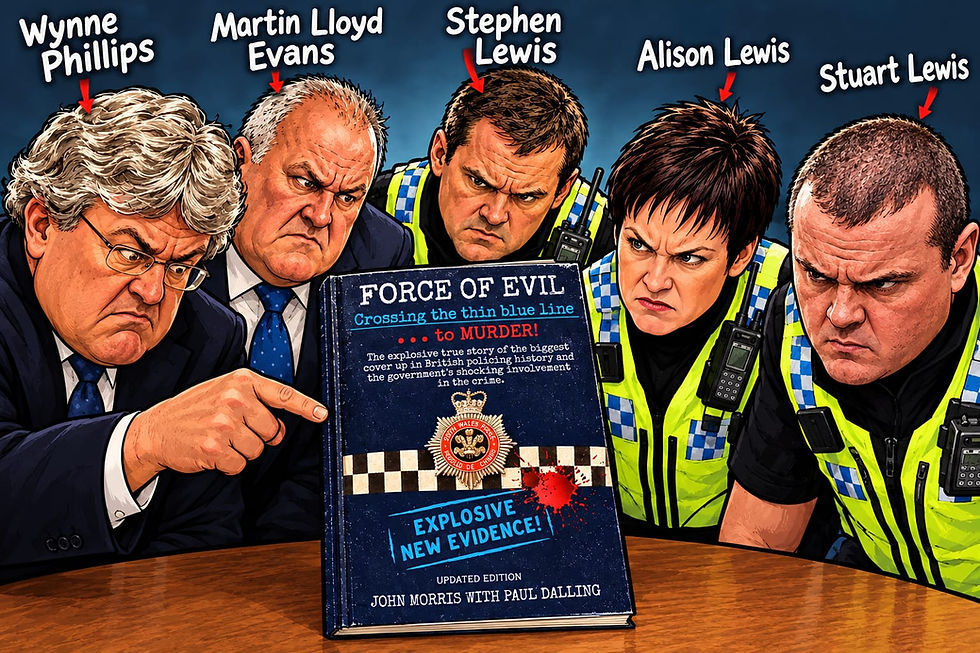
Paul Dalling has a background in construction and engineering, but he has spent the last twenty six years painstakingly investigating the Clydach murders. Paul and John are the co-authors of "Force of Evil: Crossing the thin blue line to murder" which exposes the corruption and conspiracy behind the Clydach murders, and the proven imprisonment of David George Morris, an innocent man.
Please let us know if you think that there is a mistake in this article, explaining what you think is wrong and why. We will correct any errors as soon as possible.


I believe from the start Dai never committed them murders have read the book saw the TV documentary which proves he was innocent such a awful miscarriage of justice poor man locked away for a crime he never done.