
#9 The CCRC, David Morris and the Clydach murders: A Puzzling Question

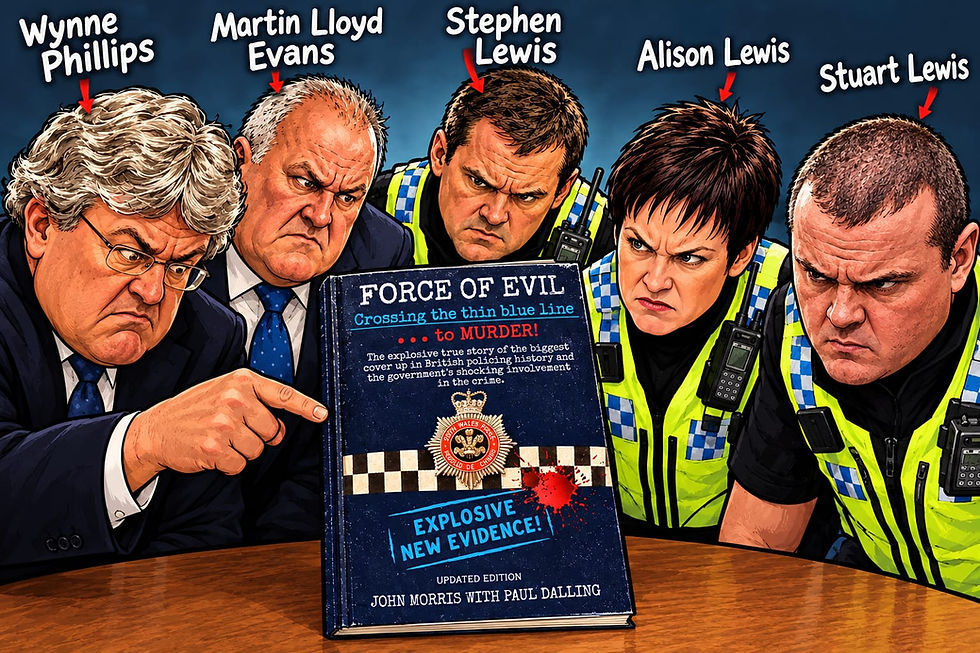
One question (amongst a great many questions) about the Clydach murders investigation has rankled me for a very long time, and it is this. I don’t understand why former South Wales Police Detective Superintendent Wynne Phillips, the head of CID, drove all the way from Swansea to Yorkshire to take a barrister’s advice on an evidential aspect of the case.
In the 2023 UK television documentary on the Clydach murders, Cold Cases – Dream of Murder, Wynne Phillips, said he drove up to Yorkshire to meet a barrister in his chambers to determine if the evidence in his possession justified prosecuting all three Lewises.
The advice on evidence, subsequently provided by this unknown barrister was, quite obviously, insufficient, to justify charging the Lewises with any crime at all.
This outcome is hard, if not impossible to believe.
But my questions is, why did this senior police officer decide that he needed to drive from Swansea to Yorkshire – a roundtrip of some 500 miles which would have taken about 10+ hours driving, with possibly an overnight stay also – when there were numerous competent senior Crown Prosecution Service (CPS) barristers capable of providing such advice literally on his doorstep? Wasn’t this trip totally unnecessary; a misuse of public funds, a slap in the face for Swansea‘s own CPS?
The Crown Prosecution Service is an independent, non-ministerial government department which makes charging and prosecution decisions entirely separate from both police and/or government. Prosecutors investigate files submitted by the police, decide whether cases meet the legal criteria and determine appropriate charges, and present cases in court.
Putting it bluntly, the CPS is both highly professional but, even more important, they are independent of both police and government. They would have been the obvious choice to provide an advice on evidence, yet, for reasons he has yet to explain, Wynne Phillips chose not to instruct them, which raises the suspicion that something was very wrong with the Clydach murders investigation.
In the Code for Crown Prosecutors it states inter alia that: “Prosecutors must always act in the interests of justice and not solely for the purpose of obtaining a conviction.”
And, “In England, Wales, and Northern Ireland, the police do not independently make the final decision to prosecute for most serious crimes; instead, they refer cases to independent prosecutors—such as the Crown Prosecution Service (CPS) or the Public Prosecution Service [my italics].
Isn’t the CPS exactly what Wynne Phillips wanted? Independent legal advice on whether or not to prosecute the Lewises on the basis of evidence which was then in the possession of South Wales Police.
And, why choose a barrister in Yorkshire? Why not Cardiff just 40 miles away, where there were almost a dozen Queen’s Counsel (today, known as King’s Counsel) specializing in criminal law based directly within the city’s major chambers, or London, less than 200 miles away, where at least 80 QCs (KCs) all practice criminal law, any one of whom was sufficiently well qualified to advise Wynne Phillips and South Wales Police on evidence.
But no, Detective Superintendent Wynne Phillips, head of CID, inexplicably chose to instruct counsel in far off Yorkshire who, predictably some might say, advised that there was insufficient evidence to prosecute the Lewises.
This, of course, raises the question as to what evidence exactly did Wynne Phillips provide to him, which justified the barrister’s advice that there was insufficient evidence to prosecute because, as we know from our own investigations, all set out in our book, Force of Evil: Crossing the thin blue line to murder, there was a very great deal of evidence indeed against all three Lewises that, in my view, and in the belief of a great many others, would have justified the police in charging them for their involvement in the murders.
Why did Wynne Phillips instruct this particular barrister? Who was this unknown barrister? What was the evidence provided to him? Can we see a copy of the advice he provided? We want to know. The public wants to know. We paid for the advice and, surely, we are entitled to know.
I invite former Detective Superintendent Wynne Phillips to respond.
By John Morris
John Morris qualified as a solicitor in England and Wales in 1987 and worked in two leading Swansea criminal law practices before taking over an existing general practice which he ran for 10 years. In 2000, he moved to Ireland where he worked in a Dublin general practice. He took early retirement in 2015 to research and write "The Clydach Murders: A Miscarriage of Justice". He continues his research into the case, He has published several other books, and he also writes for a national magazine.
With Paul Dalling, John is the co-author of "Force of Evil: Crossing the thin blue line to murder" which exposes the corruption and conspiracy behind the Clydach murders, and the proven imprisonment of David George Morris, an innocent man.
Please let us know if you think that there is a mistake in this article, explaining what you think is wrong and why. We will correct any errors as soon as possible.


Comments