
#11 CCRC accept the application for David Morris: Will they be courageous enough to get to the truth of the Clydach murders?


At the start of David Morris’s eleven-week trial for murder, heard at Swansea Crown Court in the spring and early summer of 2002, Defence Counsel Peter Rouch QC, as he then was, told the presiding judge Mr Justice Butterfield that a criminal conspiracy had taken place involving senior South Wales Police officers and others.
What we did not know then was just how insidious, how far reaching, and just how high up the official ladder this shameful conspiracy went.
It was only after many thousands of hours of investigative work, appeals for information, minutely examining documents and exhibits, analysing documentaries and commentaries, tracking down, talking to, and taking statements from witnesses, and very much more over 25 years+ of dedicated graft, most of the leg work undertaken by determined forensic investigator, Paul Dalling, the whole shocking picture of conspiracy and corruption in the Clydach murders investigation finally emerged.
It was nothing that we, or perhaps anyone unacquainted with duplicitous police practices, could have anticipated or imagined. Where we expected to find the results of tireless, meticulous, police work, we found instead, concealment, corruption and abuses of power on a horrifying scale.
Where, in normal circumstances, we would have expected South Wales Police detectives, to be honest, disciplined and trustworthy, we found many of them to be dishonest, undisciplined and untrustworthy. They were, for the most part, a law unto themselves and behaved abdominally. Likewise their superiors, from whom we quite properly expected truth, enlightenment and decency, were, characterized by dishonesty, concealment and deviousness.
Furthermore, politicians and government officials, who involved themselves in the case, were more motivated by their political agendas and personal gains than they were in upholding the rule of law.
All of which resulted in a police investigation that was so tainted and corrupted by insidious practices, ambitions and goals, and encouraged by some of those in central government, that it allowed the framing of an innocent man for a crime he did not commit, and who later died in jail always proclaiming his innocence.
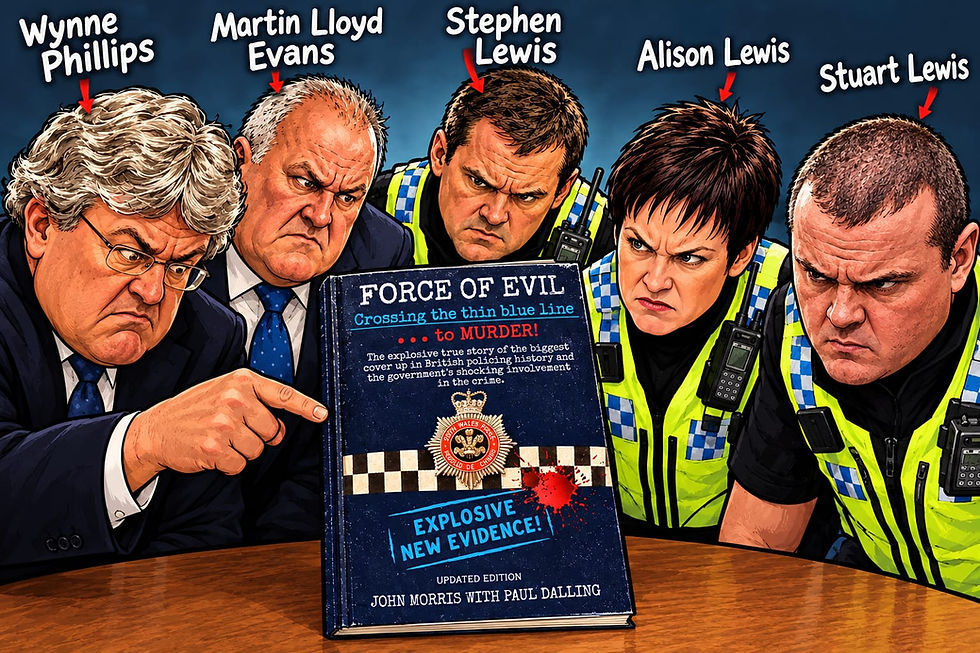
All of which we set out in our book, Force of Evil: Crossing the thin blue line to murder, the contents of which, were the basis of our application to the Criminal Cases Review Commission (CCRC) alleging that a miscarriage of justice had taken place.

The CCRC claims on its website that it is ‘…the independent body that investigates potential miscarriages of justice in England, Wales and Northern Ireland.’ Their service is both free and unique, because the CCRC is the only organisation that can send cases back to the courts for a fresh appeal. Applications can be made by anyone who believes they have been wrongly convicted (or if deceased, by their descendants) or sentenced and who has lost an appeal. And since its creation in 1997 they have referred 940+ cases to the courts of people who applied to them – an average of around one referral every 11 days.
What the CCRC website does not do, however, is advertise its failings on the website.
As recently as May 2025 a Justice Committee warned, The Criminal Cases Review Commission’s (CCRC) leadership “has shown a remarkable inability to learn from its own mistakes” despite being an organisation designed to identify failures within the criminal justice system. The CCRC’s leadership demonstrated an "inability to learn from its own mistakes," demanding "root and branch reform.
A review by the Crown Prosecution Service Inspectorate (HMCPSI) criticized internal processes as convoluted and inefficient, noting a lack of quality assurance, poor case management oversight, and instances where work delegated to legal interns was left improperly checked.
Critics and inspectors flagged a shift toward a remote-first operational culture, reduced commissioner involvement compared to past decades, staff recruitment delays, and funding strains from prior budget cuts.
Out of thousands of applications received annually (e.g., over 1,600 to 1,800+ per year), the CCRC refers a very small fraction—averaging roughly 26 referrals per year since its inception in 1997—to the Court of Appeal.
Empowering the Innocent (ETI) and others argue that the statutory "real possibility test"—which requires the CCRC to ask whether the Court of Appeal would likely quash the conviction rather than whether the person is innocent—makes the CCRC a conservative gatekeeper rather than a bold champion of justice.
CCRC investigations are sometimes hindered because the body lacks statutory authority to compel the handover of critical private-sector data, medical reports, or forensic records.
These are just some of the many complaints the CCRC has received since its inception, but notwithstanding, on 8 June 2026 we lodged our application on behalf of the family of David Morris (dec’d). It included 52 complaints of wrongdoing by South Wales Police officers, all of which, we believed, should be fully investigated by the CCRC in accordance with their stated objectives and procedures.
On 4 November, we were informed that our application had been accepted and the investigation process would now proceed.
Our part in the appeal process has not ended, it is an ongoing investigation as both Paul Dalling and I continue to follow lines of enquiry as we seek to provide the evidence that will set aside this terrible injustice. We have been invited by the CCRC to provide them with all and any evidence which comes to hand. So if you have any information, no matter how small or insignificant you feel it may be, please get in touch and let us know. You may use this email: theclydachmurders@gmail.com
This is your one and final chance to help us get the truth and justice we all deserve. Not only for the Morris family, but for the victims’ families too, and for all those whose lives have been affected by what we believe is the worst case of corruption in British policing history.
As Winston Churchill said after the Allied victory at the Second Battle of El; Alamein in North Africa
"Now this is not the end. It is not even the beginning of the end. But it is, perhaps, the end of the beginning"
Four years later, World War II was over and the battle was won.
Our Clydach murders investigation has, thus far, taken considerably longer. We can only hope that we will be similarly successful.
y John Morris and Paul Dalling
John Morris qualified as a solicitor in England and Wales in 1987 and worked in two leading Swansea criminal law practices before taking over an existing general practice which he ran for 10 years. In 2000, he moved to Ireland where he worked in a Dublin general practice. He took early retirement in 2015 to research and write "The Clydach Murders: A Miscarriage of Justice". He continues his research into the case, He has published several other books, and he also writes for a national magazine.
Paul Dalling has a background in construction and engineering, but he has spent the last twenty six years painstakingly investigating the Clydach murders. Paul and John are the co-authors of "Force of Evil: Crossing the thin blue line to murder" which exposes the corruption and conspiracy behind the Clydach murders, and the proven imprisonment of David George Morris, an innocent man.
Please let us know if you think that there is a mistake in this article, explaining what you think is wrong and why. We will correct any errors as soon as possible.

Comments