
#4 Were the Clydach murders a 'massacre'?

Updated: Oct 14

In his opening statement to the jury in the trial of David George Morris at Swansea Crown Court in 2002, prosecuting Counsel, Patrick Harrington QC, described the murders as a massacre, before he was ordered to tone his language down.
But Patrick Harrington was right. Given the extreme nature of the violence used, and the catastrophic nature of the victims’ injuries, ‘massacre’ was certainly the appropriate choice of word.
Only it was a massacre that did not, and could not have involved David Morris.
Kelvin Road is a quiet residential street in a quiet residential village, which, apart from the occasional car driving along, footsteps of passers-by, and the shouted “good night” from parting companions, is usually pin-drop silent. It was this near-perfect silence, late on the night of Saturday and Sunday 26/27 June 1999, the very time the murders were committed, that doesn’t add up.
Living in the semi-detached house next door, separated only by a thin partition wall, were Timothy and Manon Cherry who were in bed sleeping. Almost immediately opposite 9 Kelvin Road, Rosemary Jones lived with her adult son, Wayne, whose girlfriend was also there that night. All three of them were up and about, occasionally going out onto the pavement where they waited for a taxi to take Wayne’s girlfriend home. Also living almost immediately opposite was BP chemical worker, Robert Wachowski. Donald Jones and his mother lived nearby, as did off-duty firefighter, Adrian Humphries. There were many other residents in their homes that night who enjoyed the peace and quiet that night time brought to Kelvin Road.
It has already been established that Doris Dawson died first, and then the killer or killers lay in wait for Mandy and her daughters to come home. Soon after they arrived at 11.48 pm, they were all brutally murdered.
The killer used a steel bar to attack all the victims, striking each of them several times using great force. But if the attack unfolded in this way, as he (or she) attacked one victim, what were the other two victims doing?
If the killer attacked Mandy first, wouldn’t the two little girls have screamed and shouted and desperately cried out in terror, hysterically banging on the party wall, perhaps even ran out of the front door and yelled for help from their neighbours, from anyone? And, if one of the little girls was attacked first, wouldn’t Mandy have screamed at the top of her voice for the violence to stop, fought like a tiger, and shouted out to her friends and neighbours for their assistance.
In this likelihood, the fresh scram marks that Louise Pugh said she saw on Stephen Lewis’s neck and chest spring to mind, which he must explain.
But, despite so many friends and neighbours living close by on this quiet street on this quiet night, none of them heard a thing. No one heard screams or shouts, or banging, or any sounds at all that indicated a violent frenzied attack was taking place.
How could this be?
One possible answer might be that the killer was not alone. This is not a possibility that the police were prepared to entertain, because they were so intent on pinning the murders on David Morris as a sole attacker, even though his DNA and fingerprints were nowhere to be found in the house, not even on the murder weapon.
But, if the killer had an accomplice or accomplices, then this could explain the lack of sound emanating from the house. In this scenario, all three victims would have been accosted as soon as they walked in through the front door. Hands immediately clapped over their mouths of all of them, and held tightly to prevent them making any sound whatever, or running away.
This suggests that there were possibly four attackers waiting in the house for Mandy and her daughters to return home: one each to restrain Mandy and the two girls, and one to wield the murder weapon.
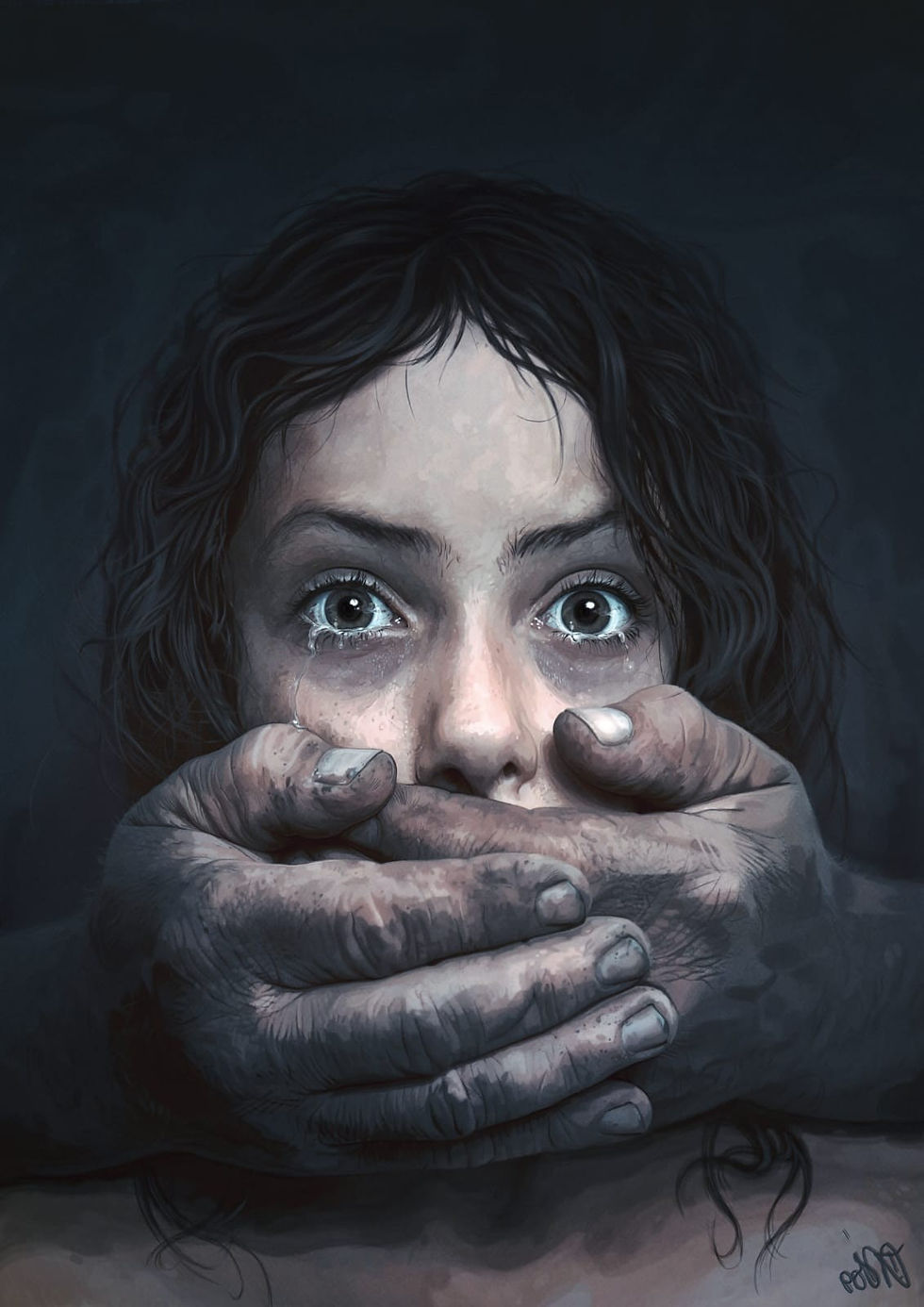
An artist’s impression of Katie being restrained.

An artist’s impression of Emily being restrained.

An artist’s impression of Mandy Power fighting with her attackers. It may have taken more than one attacker to restrain Mandy Power.
Whilst all this is mere speculation, the fact remains that the Clydach murders was one of the most, if not the most, vicious and brutal murders ever committed in the country. Four people ruthlessly killed in their own home in the middle of a quiet residential neighbourhood, and absolutely nobody heard a thing.
Was, or could, this dreadful crime have been committed by a lone attacker, or was that simply not credible as seems likely, and others were also involved?
By John Morris and Paul Dalling
John Morris qualified as a solicitor in England and Wales in 1987 and worked in two leading Swansea criminal law practices before taking over an existing general practice which he ran for 10 years. In 2000, he moved to Ireland where he worked in a Dublin general practice. He took early retirement in 2015 to research and write "The Clydach Murders: A Miscarriage of Justice". He continues his research into the case, He has published several other books, and he also writes for a national magazine.
Paul Dalling has a background in construction and engineering, but he has spent the last twenty six years painstakingly investigating the Clydach murders. Paul and John are the co-authors of "Force of Evil: Crossing the thin blue line to murder" which exposes the corruption and conspiracy behind the Clydach murders, and the proven imprisonment of David George Morris, an innocent man.
Please let us know if you think that there is a mistake in this article, explaining what you think is wrong and why. We will correct any errors as soon as possible.


Comments